Kenmore Dryer Model 970 Manual: A Comprehensive Guide
This manual provides essential guidance for Kenmore Dryer Model 970 owners, offering detailed parts lists, diagrams, and repair assistance through Repair Clinic’s resources.
Accessing model-specific information like 970.C9005200, 970.C8005200, and 970.C8004200 simplifies troubleshooting and ensures effective maintenance for your appliance.
The Kenmore Dryer 970 series represents a popular line of laundry appliances known for their reliability and performance. This series encompasses various models, including the 970.C9005200, 970.C8005200, and 970.C8004200, each designed to meet diverse laundry needs. Understanding the core features and functionalities of this series is crucial for optimal operation and maintenance.
This comprehensive guide aims to provide Kenmore Dryer 970 owners with the necessary information to effectively utilize and care for their appliance. Whether you’re a first-time user or a seasoned homeowner, this manual will walk you through everything from basic operating instructions to advanced troubleshooting techniques. Resources like Repair Clinic offer detailed parts lists, diagrams, and manuals specifically tailored to your model, ensuring easy access to repair assistance when needed.
Properly understanding your dryer’s capabilities will extend its lifespan and ensure consistently excellent results with every load.
Understanding Model Numbers: 970.C9005200, 970.C8005200, 970.C8004200 & Others
Kenmore Dryer Model 970 series utilizes a specific numbering system to identify variations within the line. Numbers like 970.C9005200, 970.C8005200, and 970.C8004200 aren’t simply random; they denote specific configurations, features, and manufacturing dates. Identifying your exact model number is paramount when seeking replacement parts or accessing model-specific documentation.
The model number is typically found on a label located inside the dryer door, on the back panel, or within the dryer’s housing. Repair Clinic emphasizes the importance of this number when searching for parts, diagrams, and manuals. Using the correct model number guarantees compatibility and prevents ordering incorrect components.
Variations in these numbers can indicate differences in features like sensor type, heating element wattage, or control panel design. Accurate identification streamlines the repair process and ensures optimal dryer performance.
Safety Precautions Before Using Your Kenmore Dryer
Prioritizing safety is crucial when operating your Kenmore Dryer Model 970. Always ensure the dryer is properly grounded to prevent electrical shock. Never operate the dryer if it’s damaged, particularly the power cord or plug. Inspect the vent hose regularly for obstructions and ensure it’s not kinked or crushed, as this poses a fire hazard.
Keep flammable materials away from the dryer, including liquids, aerosols, and fabrics treated with flammable substances. Do not dry items that have been soaked in flammable solvents. Always disconnect the dryer from the power supply before cleaning or performing any maintenance.
Supervise children closely when they are near the dryer. Never allow them to play with the controls or climb inside. Regularly clean the lint filter after each load to maintain efficient operation and reduce fire risk.

Operating Instructions
Effectively utilize your Kenmore Dryer Model 970 by understanding loading procedures, cycle selections, control panel features, and moisture sensor functionality for optimal results.
Loading and Unloading the Dryer
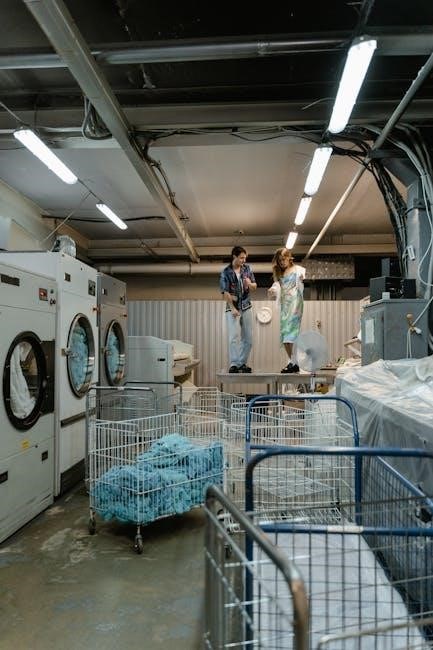
Proper loading is crucial for efficient drying and preventing damage to your clothes and the Kenmore Dryer Model 970. Always ensure the dryer drum is empty before loading a new batch. Separate items by fabric type and weight – heavier items like towels should be dried separately from lighter items like delicates.
Avoid overloading the dryer, as this restricts airflow and can lead to uneven drying and increased drying times. A good rule of thumb is to fill the drum no more than two-thirds full. When loading, ensure items are not blocking the lint filter or the air intake vents.
After the drying cycle is complete, promptly remove clothes to prevent wrinkling and static cling. Shake out each item before folding or hanging. Regularly check pockets for any forgotten items before loading to avoid potential hazards.
Be mindful of items with embellishments or delicate materials, considering using a garment bag for added protection during the drying process.
Selecting the Correct Drying Cycle
The Kenmore Dryer Model 970 offers a variety of drying cycles to cater to different fabric types and drying needs. Understanding these cycles is key to achieving optimal results and preventing damage to your garments. Common cycles include Normal, Delicate, Timed Dry, and Air Fluff.
For everyday items like cotton and linen, the Normal cycle is generally suitable. Delicate fabrics, such as lingerie and silk, require the gentle heat of the Delicate cycle. Timed Dry allows you to set a specific drying time, ideal for small loads or items that need a quick refresh.
Utilize the Moisture Sensor cycle for automatic drying based on the moisture level of the clothes. Always refer to the garment care label for specific drying instructions before selecting a cycle. Incorrect cycle selection can lead to shrinkage, fading, or damage.
Experiment with different cycles to find what works best for your laundry habits and fabric preferences.
Understanding Control Panel Features
The Kenmore Dryer Model 970’s control panel is designed for intuitive operation, offering a range of settings to customize your drying experience. Key features include cycle selection knobs or buttons, temperature control options (High, Medium, Low, Air Dry), and start/pause buttons.
Digital displays, if equipped, show remaining drying time and cycle status. Many models feature options like wrinkle shield, which periodically tumbles clothes after the cycle ends to minimize creases. The moisture sensor function is often activated via a dedicated button.
Familiarize yourself with the indicator lights that signal cycle progress, heating status, and any error codes. Refer to the manual for a detailed explanation of each control panel feature and its corresponding function. Proper understanding ensures efficient and effective dryer operation.
Experiment with the settings to achieve the desired drying results for various fabric types.
Using the Moisture Sensor Function
The Kenmore Dryer Model 970 incorporates a moisture sensor, a smart feature designed to automatically detect the dampness level of your clothes. This prevents over-drying, saving energy and protecting fabrics from unnecessary wear and tear. To activate, select a cycle with a moisture sensor option – often labeled “Automatic” or “Sensor Dry.”
The dryer’s sensors continuously monitor moisture levels during the cycle. Once the clothes reach the selected dryness level, the dryer will automatically shut off, even if the timer hasn’t fully elapsed.
For optimal performance, avoid overloading the dryer, as this can hinder the sensor’s ability to accurately detect moisture. Clean the moisture sensor bars regularly (refer to the maintenance section) to ensure accurate readings. This feature provides convenience and efficiency.
Adjusting Drying Temperature Settings
The Kenmore Dryer Model 970 offers adjustable temperature settings to accommodate various fabric types and drying needs. Typically, you’ll find options like “High Heat,” “Medium Heat,” and “Low Heat” or “Delicate.” Always consult the care labels on your garments to determine the appropriate temperature.
High heat is suitable for durable fabrics like towels and cottons, while medium heat works well for synthetics and blends. Low heat or the delicate setting is ideal for sensitive items like lingerie, sweaters, and items prone to shrinking.
Using the correct temperature prevents damage and ensures optimal drying results. Some cycles automatically adjust the temperature based on the selected fabric type, offering added convenience. Incorrect temperature settings can lead to fabric damage or inefficient drying.

Maintenance and Troubleshooting
Regular maintenance extends your Kenmore 970 dryer’s life, while troubleshooting guides from Repair Clinic assist with common issues like heating or starting problems.
Cleaning the Lint Filter – Importance and Procedure
Maintaining a clean lint filter is paramount for safe and efficient dryer operation. A clogged lint filter restricts airflow, leading to longer drying times, increased energy consumption, and a potential fire hazard. Always clean the lint filter before each load.
Procedure: Locate the lint filter, typically inside the dryer drum near the door. Gently remove the filter – it may slide out or lift up. Use your fingers or a soft brush to remove the accumulated lint. For stubborn residue, you can occasionally wash the filter with mild soap and water, ensuring it’s completely dry before reinstalling.
Regularly inspect the lint filter housing for any accumulated lint that may have bypassed the filter. Vacuuming this area will further enhance dryer performance and safety. Ignoring lint buildup compromises dryer functionality and poses a significant risk.
Cleaning the Dryer Vent – Preventing Fires
A clean dryer vent is crucial for preventing fires and maintaining optimal dryer performance. Lint accumulation within the vent restricts airflow, causing the dryer to overheat and potentially ignite the lint. It’s recommended to clean the dryer vent at least once a year, or more frequently if you notice longer drying times or the dryer feels excessively hot.
Procedure: Disconnect the dryer from the power source. Locate the vent opening on the exterior of your home and carefully detach the vent hose from both the dryer and the wall. Use a dryer vent cleaning kit – available at most hardware stores – or a vacuum with a long hose attachment to remove lint buildup.
Ensure all connections are secure after cleaning to prevent leaks. A blocked vent significantly increases fire risk and reduces drying efficiency. Prioritize vent cleaning for safety and appliance longevity.
Troubleshooting Common Dryer Problems
Encountering issues with your Kenmore Dryer 970? Several common problems can be addressed with basic troubleshooting. If the dryer isn’t starting, check the power cord, circuit breaker, and door switch – ensuring the door is fully latched. For a dryer not heating, a faulty heating element or thermostat is often the culprit.
Unusual noises could indicate a worn drive belt, damaged drum rollers, or foreign objects lodged within the dryer. Clothes taking too long to dry usually point to a clogged lint filter or restricted vent. Repair Clinic provides diagrams and videos to assist with diagnosis.
Always disconnect power before inspecting internal components. Refer to the parts list for accurate identification and replacement options.
Dryer Not Starting
If your Kenmore Dryer 970 fails to start, begin with the simplest checks. Verify the power cord is securely plugged into a functioning outlet. Inspect the circuit breaker or fuse box to ensure the dryer’s circuit hasn’t tripped or blown. A tripped breaker often indicates an overload.
Crucially, check the door switch; the dryer won’t operate if the door isn’t completely latched. A faulty door switch is a common issue. Consult Repair Clinic’s diagrams to locate and test the switch. If these steps don’t resolve the problem, further investigation of the motor or control board may be necessary.
Remember to disconnect power before any internal inspection.
Dryer Not Heating
When your Kenmore Dryer 970 isn’t heating, the most frequent culprit is a faulty heating element. Utilize Repair Clinic’s parts diagrams to locate the heating element specific to your model (e.g., 970.C9005200). Before diagnosing, ensure the dryer is receiving power and the motor is running – a non-heating issue differs from a no-start situation.
A broken thermostat can also prevent heating. Test the thermostat using a multimeter to confirm its functionality. If the thermostat is defective, replacement is necessary. Always disconnect power before accessing internal components. Repair Clinic provides step-by-step guides for heating element and thermostat replacement.
Remember safety first when working with electrical components.
Dryer Making Unusual Noises
Unusual noises from your Kenmore Dryer 970 often indicate mechanical issues. A common source is a worn drive belt; Repair Clinic’s diagrams will help you identify the correct replacement for your specific model (like 970.C8005200). A squealing sound frequently points to a slipping or broken belt. Thumping noises could suggest worn drum support rollers or a foreign object lodged within the dryer.
A failing motor can produce grinding or humming sounds. Inspect the motor for any visible damage. Repair Clinic offers visual guides for replacing the drive belt and accessing the motor. Always disconnect power before attempting any repairs. Ensure proper alignment when installing a new belt to prevent premature wear and noise.
Prioritize safety during all repair procedures.
Clothes Taking Too Long to Dry
If your Kenmore Dryer 970 is taking an extended time to dry clothes, several factors could be at play. A clogged lint filter is a primary culprit – cleaning it after each load is crucial. A restricted dryer vent significantly reduces airflow; regular cleaning (as detailed in the maintenance section) is essential to prevent fire hazards and improve drying efficiency.
A malfunctioning heating element will drastically increase drying times. Repair Clinic provides parts diagrams to help locate and replace the heating element for models like 970.C9005200. A faulty thermostat may also prevent the dryer from reaching the correct temperature. Utilize Repair Clinic’s resources for step-by-step repair guides and part identification.
Overloading the dryer can also contribute to longer drying cycles.

Parts and Diagrams
Locating replacement parts for your Kenmore Dryer 970 is simplified through Repair Clinic’s extensive catalog, diagrams, and manuals for models like 970.C9005200.
Locating Replacement Parts for Kenmore Dryer 970
Finding the correct replacement parts for your Kenmore Dryer Model 970 is now easier than ever, thanks to resources like Repair Clinic. They specialize in providing parts lists, diagrams, and manuals specifically tailored to your dryer’s model number – whether it’s 970.C9005200, 970.C8005200, 970.C8004200, or another variation within the 970 series.
Repair Clinic’s website allows you to search by model number, ensuring compatibility and a proper fit. This eliminates guesswork and reduces the risk of ordering incorrect components. They stock a wide range of parts, including heating elements, thermostats, drive belts, and motors – all essential for maintaining your dryer’s functionality. Detailed diagrams help you identify the exact part you need, and their support team is available to assist if you encounter any difficulties during the process.
Using the correct part number is crucial, and Repair Clinic provides this information alongside each part listing. This ensures a seamless repair experience and gets your Kenmore dryer back to optimal performance quickly and efficiently.
Understanding Parts Diagrams
Parts diagrams are invaluable tools when repairing your Kenmore Dryer Model 970, offering a visual representation of the dryer’s internal components. Resources like Repair Clinic provide these diagrams, specifically tailored to each model number – including 970.C9005200, 970.C8005200, and 970.C8004200 – ensuring accuracy.
These diagrams illustrate the location and relationship of each part, making it easier to identify the component you need to replace. Parts are typically numbered, corresponding to a parts list that provides descriptions and part numbers. Understanding the diagram’s key is essential; it explains the symbols and conventions used.
Diagrams help visualize how parts fit together during reassembly, preventing errors and ensuring proper functionality. Repair Clinic’s diagrams are designed to be user-friendly, even for those with limited repair experience. Utilizing these visual guides significantly simplifies the repair process and increases the likelihood of a successful outcome for your Kenmore dryer.
Common Replacement Parts: Heating Element
The heating element is a frequent replacement part in Kenmore Dryer Model 970 series dryers, as it’s responsible for generating heat during the drying cycle. If your dryer isn’t heating, a faulty heating element is a prime suspect. Repair Clinic offers a comprehensive selection of heating elements compatible with various 970 models, including 970.C9005200 and 970.C8005200.
Symptoms of a failing heating element include no heat or insufficient heat, even when the dryer is running. Replacing the heating element requires disconnecting power and accessing the dryer’s internal components. Always consult the parts diagram to ensure you order the correct element for your specific model.
Repair Clinic provides detailed instructions and videos to guide you through the replacement process. Safety is paramount; always disconnect the power supply before beginning any repairs. A functioning heating element is crucial for efficient drying, restoring your Kenmore dryer to optimal performance.
Common Replacement Parts: Thermostat
The thermostat in your Kenmore Dryer Model 970 plays a vital role in regulating the dryer’s temperature, preventing overheating and ensuring safe operation. If your dryer is overheating, shutting off mid-cycle, or clothes are taking excessively long to dry, a faulty thermostat could be the cause. Repair Clinic stocks a variety of thermostats compatible with different 970 series models, like 970.C9005200 and 970.C8004200.
A malfunctioning thermostat can disrupt the heating cycle, leading to inconsistent drying performance. Replacing the thermostat involves accessing the dryer’s internal components and disconnecting electrical connections. Referencing the parts diagram is essential for identifying the correct thermostat for your specific dryer model.
Repair Clinic offers step-by-step guides and videos to assist with the replacement process. Remember to disconnect the power supply before starting any repairs for safety. A properly functioning thermostat is key to maintaining consistent and safe drying temperatures.
Common Replacement Parts: Drive Belt
The drive belt in your Kenmore Dryer Model 970 is crucial for transferring power from the motor to the drum, enabling the tumbling action necessary for drying clothes. A worn or broken drive belt will prevent the drum from rotating, resulting in the dryer not functioning correctly. Repair Clinic provides a selection of drive belts compatible with various 970 series models, including 970.C9005200 and 970.C8005200.
Signs of a failing drive belt include squealing noises during operation, or the drum not turning at all. Replacing the drive belt typically involves accessing the dryer’s interior and navigating around other components. Utilizing the parts diagram will help you locate the correct belt and understand its positioning.
Repair Clinic offers visual guides and instructional videos to simplify the replacement process. Always disconnect the power before beginning any repairs to ensure safety. A new drive belt restores proper drum rotation and efficient drying performance.
Common Replacement Parts: Motor
The motor is the powerhouse of your Kenmore Dryer Model 970, responsible for rotating the drum and facilitating the drying process. If your dryer isn’t starting, or the drum is moving weakly, a faulty motor could be the culprit. Repair Clinic stocks a range of motors designed to fit various 970 series models, including 970.C9005200 and 970.C8004200, ensuring compatibility and reliable performance.
Diagnosing a motor issue often requires a multimeter to test for continuity and voltage. Replacing the motor is a more complex repair, typically involving disassembly of the dryer’s cabinet and careful reconnection of wiring. Referencing the parts diagram is essential for proper installation.

Repair Clinic provides detailed diagrams and videos to guide you through the motor replacement process. Remember to disconnect the power supply before undertaking any repairs for safety. A functioning motor ensures efficient and effective drying.

Advanced Troubleshooting & Repair
For complex issues, utilize a multimeter to test components, and consult Repair Clinic’s guides for detailed instructions on motor or heating element replacement.
Using a Multimeter to Test Components
Diagnosing Kenmore Dryer 970 issues often requires testing electrical components with a multimeter. Before beginning, always disconnect the dryer from the power source to ensure safety. Begin by testing the heating element for continuity; a lack of continuity indicates a break in the element, necessitating replacement.
Next, check the thermostat for continuity as well, as a faulty thermostat can prevent the dryer from heating. The thermal fuse, another critical component, should also be tested for continuity – a blown fuse will halt operation.
To test the drive motor, check for voltage when the dryer is supposed to be running. If voltage is present but the motor doesn’t run, the motor itself is likely faulty. Remember to consult wiring diagrams (available through Repair Clinic) to identify the correct terminals for testing. Accurate multimeter readings are crucial for pinpointing the root cause of the problem and avoiding unnecessary part replacements.
Replacing the Heating Element – Step-by-Step
Replacing the heating element in your Kenmore Dryer 970 begins with disconnecting power. Access the element by removing the dryer’s rear panel – typically secured with screws. Carefully disconnect the wires connected to the old heating element, noting their positions for reassembly.
Remove the mounting screws holding the element in place and gently slide the old element out. Before installing the new element, inspect the element mounting bracket for any damage. Insert the new heating element, ensuring it’s fully seated, and secure it with the mounting screws.
Reconnect the wires, matching their original positions. Reattach the rear panel, ensuring all screws are tightened. Finally, restore power and test the dryer to confirm the new heating element is functioning correctly. Repair Clinic provides diagrams to aid in this process.
Replacing the Drive Belt – A Visual Guide
Replacing the drive belt on your Kenmore Dryer 970 requires accessing the belt compartment, usually located behind the dryer’s front panel. Begin by disconnecting the power supply. Remove the front panel, often held in place by clips or screws. Visually inspect the old belt for wear and tear – cracks or fraying indicate the need for replacement.
Release the tension on the belt tensioner pulley, allowing the old belt to be removed. Carefully route the new belt around the dryer drum, motor pulley, and tensioner pulley, ensuring a snug fit. Re-engage the tensioner pulley, securing the belt in place.
Reassemble the dryer, reattaching the front panel and reconnecting the power. Repair Clinic offers visual diagrams to guide you through each step of this process, ensuring a successful repair.
Resources for Kenmore Dryer Repair
For Kenmore Dryer 970 repairs, Repair Clinic stands as a comprehensive resource, offering a vast library of parts diagrams and manuals specifically tailored to models like 970.C9005200, 970.C8005200, and 970.C8004200. Their website provides detailed part lists, enabling you to quickly identify and order the necessary components for your repair.
Beyond parts, Repair Clinic delivers valuable visual aids – instructional videos and diagrams – that simplify complex repair procedures. These resources are particularly helpful for tasks like replacing heating elements or drive belts. Accessing these tools empowers both seasoned DIYers and beginners to tackle dryer repairs confidently.
Utilize Repair Clinic’s support to ensure a successful and efficient restoration of your Kenmore Dryer 970’s functionality.